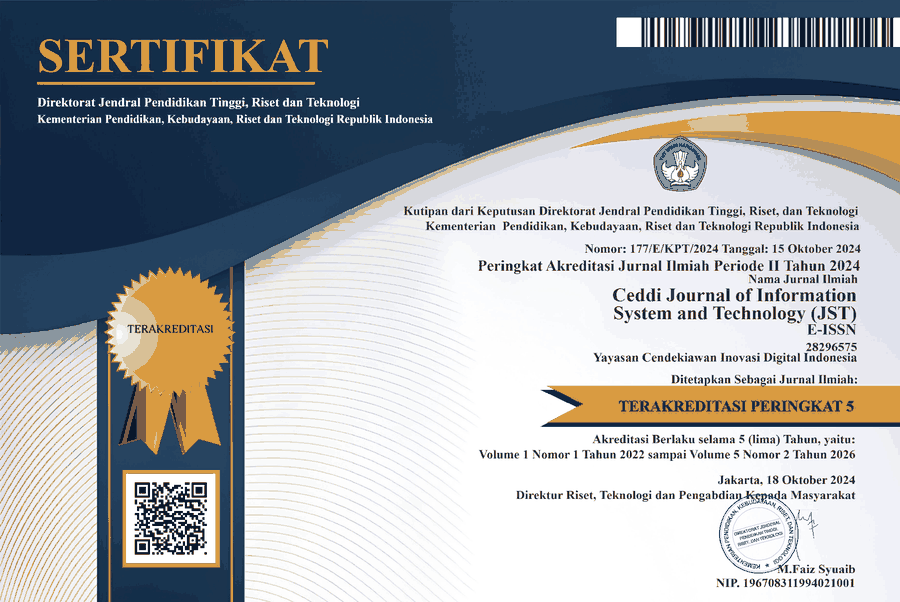
Journal History

Effective from Vol. 5 No. 2 (2026), the Ceddi Journal of Information System and Technology (JST) adopts an updated article template. The updated template requires every article to include six author declaration sections and clarifies the copyright and licensing notice in the Word template and published article PDFs. These changes aim to improve clarity, transparency, and consistency in research reporting.

Authors should use the latest template available through the Manuscript Template link and complete each declaration according to the actual circumstances of their study.

Vol. 5 No. 2 (2026) — Updated Article Template and Author Declaration Requirements

1. Mandatory Author Declarations

In earlier issues, authors were encouraged to include these declarations. From Vol. 5 No. 2 (2026) onwards, every article must include the following six sections:

  1. Funding Statement
    Identify the funding source and grant number, where applicable. If the research received no external funding, state this explicitly.
  2. Author Contributions
    Describe each author's actual contribution to the research and manuscript preparation, such as conceptualisation, methodology, software or system development, data collection, validation, analysis, writing, review, supervision, or funding acquisition. All authors must approve the final version of the manuscript.
  3. Research Ethics and Informed Consent
    Explain the ethical approval and informed consent procedures relevant to the study. Where applicable, provide the name of the approving ethics committee, the approval number and date, and the procedures used to obtain participant consent. If ethical approval or informed consent was not required, explain why.
  4. Conflict of Interest
    Disclose any potential financial, personal, professional, or institutional conflicts of interest related to the research or its publication. If no conflicts exist, state this explicitly.
  5. Data Availability Statement
    Explain whether and how the data, code, software, models, or other materials supporting the findings can be accessed. If access is restricted, state the reason and any conditions for access.
  6. Declaration of Generative AI Use
    Disclose any use of generative AI beyond straightforward language correction, editing, or formatting. Identify the tool used and describe the nature and purpose of its use. If no generative AI requiring disclosure was used, authors must state this explicitly. Generative AI tools cannot be listed as authors. Human authors remain fully responsible for the accuracy, originality, validity, confidentiality, and integrity of all submitted content.

An Acknowledgements section should be included, where applicable, to recognise individuals or organisations that supported the research but do not meet the criteria for authorship. This section may be omitted if there are no acknowledgements to make.

Guidance for authors: All six declaration sections must be retained. If a section does not apply, provide a brief explanation. All statements must accurately reflect the study and the manuscript preparation process. Replace the instructions and examples in the Word template with the appropriate declarations; instructional text must not appear in the final article.

2. Revised Wording of the Copyright and Licensing Notice

Effective from Vol. 5 No. 2 (2026), JST updates the wording of the copyright and licensing notice in the Word template and published article PDFs to make it clearer and consistent with the journal's existing policy.

Previous wording:

Ceddi Journal of Information System and Technology (JST) is licensed under a Creative Commons Attribution-NonCommercial-ShareAlike 4.0 International License.

Wording used from Vol. 5 No. 2 (2026) onwards:

© [YEAR] The Author(s). This article is licensed under a Creative Commons Attribution-NonCommercial-ShareAlike 4.0 International License.

This is a wording clarification only; it does not change copyright ownership or the licence. Authors have retained copyright from the outset, and articles continue to be published under the Creative Commons Attribution-NonCommercial-ShareAlike 4.0 International (CC BY-NC-SA 4.0) licence. The placeholder [YEAR] is replaced with the publication year of each article.

Both updates apply from Vol. 5 No. 2 (2026) onwards. Articles published in earlier issues retain the format used at the time of publication.